The Hillbilly is in a lose lose predicament. But, … land da plane, JD!
Excerpts:
Why Trump Chose Vance to Negotiate With Iran
There is no overlap between what America is demanding and what Iran is offering.
By Karim Sadjadpour
Donald Trump went to war intending to break Iran’s power. But $50 billion later, a deeply battered Islamic Republic is still standing, and with talks set to commence in Islamabad, the tables have turned. Although Trump had hoped to determine Iran’s future, Tehran may now determine his. Iran holds veto power over Trump’s legacy—and the political future of his vice president, J. D. Vance, who will lead the negotiations.
The significance of this war will be judged over decades, not weeks. But for now, the Islamic Republic is feeling triumphant. Three months ago, the global news story was about Tehran massacring its own people; today it is about Tehran successfully resisting America and Israel. Even if before the war, the United States and Israel sought to change Iran’s regime, what is being demanded now is not total surrender, but cooperation.
Iran discovered that its leverage is economic, rather than nuclear, extortion. Few countries feel directly threatened by an Iranian bomb, but most people around the world have felt the consequences of Iran’s closure of the Strait of Hormuz, a waterway through which flows nearly a quarter of the world’s seaborne oil and a fifth of its natural gas. Before the war, more than 100 vessels transited the strait daily; on April 8, just four ships passed through it. Desperation was the mother of Iran’s strategy.
The cease-fire is tenuous. Vance, meanwhile, arrives in Islamabad with the optimism of a newcomer to Middle East diplomacy. He has likened Iran’s enrichment of uranium to his wife having the right to skydive, noting that he does not want Usha to jump out of an airplane.
Both Trump and Tehran, for different reasons, have looked to Vance to end the war. White House reporters who speak with Trump regularly believe that he’s already moved on from the Iran war—recognizing that it’s a political loser—and doesn’t intend to return. When toppling the Iranian regime appeared within reach to him, Trump wanted the credit; now, sensing the war’s unpopularity, he is content to let Vance own the outcome. If a deal “doesn’t happen, I’m blaming J. D. Vance,” Trump recently joked.
Iran’s leaders have their own reasons to prefer Vance. They view him as the anti-war voice in MAGA—less sympathetic to Israel than Steve Witkoff, Trump’s special envoy to the Middle East, or Jared Kushner, his son-in-law—and highly motivated to resolve the conflict quickly, given his presidential ambitions. And if he reaches the highest office in the White House, he will be bound by whatever he signs in Islamabad.
Yet there is no overlap between what Trump is demanding and what Iran is offering. On every significant issue, the two sides are not negotiating over terms—they are negotiating over incompatible realities. Trump demands zero nuclear enrichment; Iran calls it a sovereign right. Trump demands that Iran abandon its proxies; Iran calls them “the heroic Islamic Resistance.” Trump demands that Iran suspend its use of ballistic missiles; Iran doesn’t mention them, because they are nonnegotiable. Trump offers sanctions relief as a reward; Iran demands their full removal as a baseline. Trump offers nothing on reparations; Iran demands payment for the war.
The Obama administration took nearly two years to negotiate a deal limited solely to Iran’s nuclear program. The Trump administration has two weeks to resolve the Strait of Hormuz, as well as Tehran’s nuclear, missile, and regional ambitions simultaneously. The best achievable outcome in Islamabad is not resolution but reversion—a cold conflict to replace a hot one.
Iran’s Supreme National Security Council has been brazenly candid about its objectives. In an official statement, it described the Islamabad talks as a ratification of a victory rather than a negotiation: “Within a maximum of 15 days, the details of Iran’s victory on the battlefield will also be cemented in political negotiations.” The cease-fire, it added, “does not mean the end of the war.” Vance is not flying to Islamabad to make a deal. He is flying there to hear Iran’s terms.
Trump and Vance now risk the same criticism that Republicans have leveled at Democrats for decades: Being overeager for a deal, the negotiators walk into the bazaar having already announced that they must have the rug.
The war significantly diminished Iran’s capabilities but hardened its intentions. Although Iranians have been mythologized as expert negotiators, driving a tough bargain is easy when you do not care about the consequences that your obstinacy inflicts on your own people. For two decades, Tehran’s ideology, and its insistence on uranium enrichment, has delivered neither nuclear energy nor a deterrent—and has cost Iran an estimated $1 trillion in sanctions, lost oil revenue, and now a devastating war. Uranium enrichment has impoverished national enrichment. Yet it is Trump’s presidency and Vance’s future that now depend on Iranian goodwill.
Replies to: “The Hillbilly is in a lose lose predicament. But, … land da plane, JD!”
You know who would've closed the deal? Beta Boy Blinken. I mean, look at his pedigree/credentials.
Credentials and experience getting things done. Give me Blinken and Hillary and I'd send them over lickety-split and I bet you they'd have a deal done in hours.
The biggest thing is to follow norms. We must conform to what has always been tried. Great leaders conform. I read that once. Maybe it was here, or maybe it was there, but I read it, and, dammit, it made sense. Do not deviate from norms, be it foreign policy or dreadful SCOTUS decisions from the past. Conform.
Blinken and Biden failed to restart the JCPOA
Sure, Trump would have scuttled it again. But that was the alternative to war - and it achieved the main US goal.
And sure, the Iranians get a vote. And why would they want to make a deal with a country that had proven unreliable.
Still…it was one of the biggest failures of the Biden admin.
Biden was running circles around the staff and no one could keep up with him.
This is how the return of Trump happened.
Just a few months before the JB/DJT debate...Trump never has and never will do better than Joe did..
in showing his command of the issues and ability to engage with others in meaningful dialogue. Claims to the contrary are pure political mudslinging. On his worst day, Biden was orders of magnitude better than what we are experiencing right before our eyes with Trump.
Against all evidence, you're still going with Biden was never mentally incompetent?
(no message)
Watch the video of JB’s entire SOTU speech and then try to point out a segment that illustrates
Mental Incompetence…be sure to note the time stamp and explain in your own words why you think that way.
If you can’t or won’t, then admit you misspoke….i.e. back up your accusation.
That was his principal job here from day one...

(Day one being October 8, 2020)
,,,to run the narrative that Biden (Joe...not Jill) was supposedly fit to run the country.
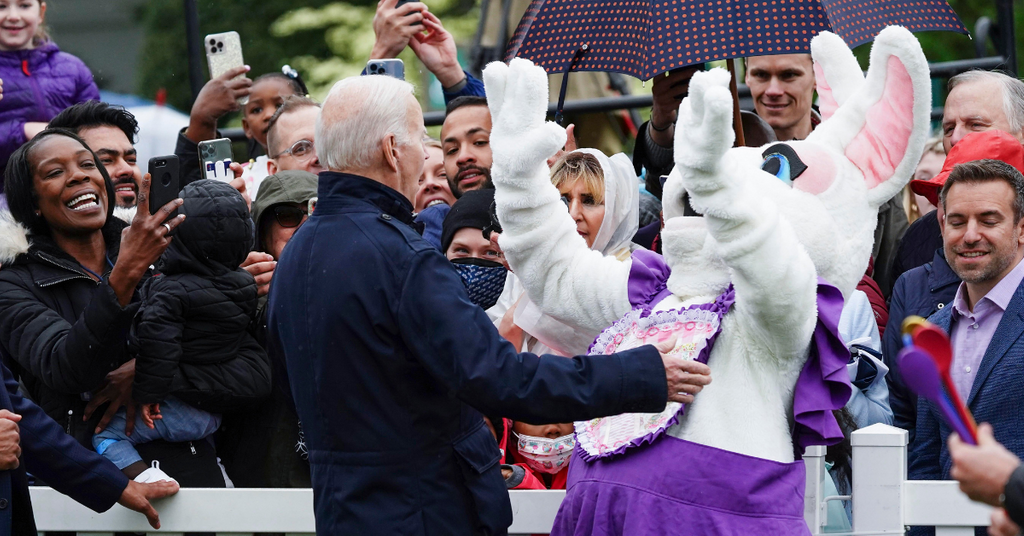
By April of 2022, the jig was up as "the President" took direction from the Easter Bunny as to who he was allowed to speak to on certain topics.
(Imagine, for a moment, Clinton or Obama being instructed by a staffer that they were no longer allowed to speak to someone of their choosing and just exactly what their reaction would be...)
Biden didn't lose his shit on the night before June 27th, 2024 (when it was readily apparent to everyone). It was a consistent degradation that had been going on for quite some time...
Those inside the White House demonstrably knew in April 2022...many knew long before that...and some knew it to be a fact on October 8, 2020.
B&B weren't successful, but at least they made some serious efforts toward that end in a very
challenging environment...no thanks to our previous President's malleability by foreign players, like Bibi and Vlad.
Link: https://www.pbs.org/newshour/world/biden-administration-responds-to-irans-offer-to-resume-nuclear-deal
Even Biden had his head in his hands after the Afghanistan debackle. 13 brave helpers left dead.
(no message)
Vance should not be our lead negotiator
He has no experience doing this. The Iranians do.
The other two fucktards are real estate developers.
No one in the US delegation has any understanding of nuclear weapons.
And hovering over all of it is the king of the morons, who thinks he is the best negotiator in the world.
We’re fucked.
really should be you or someone from the intelligentsia
(no message)
Has JD Vance ever attended the U.S. Naval War College?...much less taught at it, or the USNA for
many years? Just accept reality...JDV can't hold a candle to Chris' CV...and you are totally out of the conversation.
A Professional.
(no message)
It appears negotiations were not fruitful.
(no message)
I don’t understand why our delegation is leaving
The negotiations that led to the JCPOA took 37 straight days (after 2 years of preliminary talks).
Trump (who is at a UFC fight) apparently thinks, since he is the king of negotiations, that we need to walk away in order to get a deal. Maybe restart some bombing, in order to step up the pressure.
I don’t see it working.
It appears the US terms were unrealistic.
Ali Gholhaki, a conservative analyst close to the Iranian government, said on social media that talks fell apart because the United States demanded zero enrichment, removal of nearly 900 pounds of stockpile uranium from the country and U.S. “management of the security of the Strait of Hormuz on their own terms.” Mr. Gholhaki said the United States also provided no commitment to end Israel’s bombing of Lebanon. “It seems the Americans didn’t come to negotiate!” he said.
Hopefully it was just the opening gambit
Trump seemed to want a surrender, not a compromise.
Let’s hope the adults keep diplomatic talks alive. Cut a temporary deal.
Stop all bombing. Open the strait. Give Iran a financial cut of the ship traffic.
Then start the tough work to address the nuclear issue.
Don’t see any better path out of this shitshow.
Bullet point #11: Women will be treated as property.
The US and Israel will accept this, because otherwise there will be no free flow of oil through the strait.
The United States had these things called “national interests”
And the plight of Iranian women is not near the top.
Of course we would like to see all Iranians be free.
But peaceful co-existence almost always serves US interests better.
Maybe you’d like to invade Iran and set their women free. Worked great in 2003, after all.
Maybe a third party could get it done.
This sounds like an "America First" message.
(no message)
It’s “realism.” And we would all be better off if Trump had followed it
(no message)
I suspect the the Iranians are smarter and more adept at such things than DJT and his team of
loyalists...plus they hold the 'Trump Card'...i.e. the Strait of Hormuz. Meanwhile, Putin is milking this for all it's worth...both near and long term. Also, now Bibi has an inkling of how Zelensky feels about U.S. 'Aid' under DJT.
We have so much work to do come 2027 and onwards, cleaning up this mess.
Iranian's hold the Trump Card. Hmm, maybe not.
(no message)
Let's see what kind of deal comes out of all this...sure hope we get IAEA inspectors back on Iranian
soil and control of those 900+ lbs of 60% enriched uranium they have produced since Trump tore up the JCPOA...you know...the deal we had worked so hard over two years to get.
Because work is beneath Trump … and his voters.
(no message)
Work gets in the way of DJT's golf, philandering and TV time...always has...always will...
(no message)
Trump supporters are generally far harder workers than the new Democrats. If you don't recognize
that you are just eing silly.
Why no defense of DJT?…;-)
(no message)
It's a matter of policies for me not DJT, back in 2015 my first choice was Carson, but he was too
mellow then Marco became my next choice but Trump overwhelmed everyone and his policies were more in line with mine than Hillary. Hillary was at least capable whereas Obama and biden were not.
What policies resonate with you?
(no message)
🇬🇶 Happy Now?
(no message)
You are the one who voted for America to fail. Happy?
(no message)
Consent Management