Allen’s Creek is one of the oldest settled areas in the Town of Brighton, with roots stretching back to the late 18th century.
The area was first occupied briefly by Captain Timothy Allyn of Massachusetts, who in 1790 built a log cabin on a 500‑acre tract along the creek that now bears his name . After a summer in the wilderness, Allyn sold the land and moved to Geneva, NY, but left behind a strategically located site on the route from Canandaigua to the Irondequoit Landing — a major trade corridor for Canadian flour and supplies.
Modern archaeological work at the Allen’s Creek site has revealed deep cultural layers dating back to the Late Archaic period (about 3360–1120 B.C.), with artifacts such as Genesee points and Brewerton‑phase tools. It was shaped by the Wisconsin Glacier until 8,000 BC and is now divided by the Genesee River.
Brighton, a suburb of Rochester, was a Seneca Indian hunting ground before becoming an Erie Canal Village in 1823. These findings show that the site was occupied for thousands of years before European settlement, with evidence of both precontact and historic periods.
Brighton's first residents were native Americans, members of the Seneca tribe of the Iroquois confederacy. Their trails crossed the Genesee country, connecting Lake Ontario with the Genesee River. Settlers coming to the area after the Revolutionary War used these same trails to search out land for purchase.
The 1788 Buffalo Creek Treaty, negotiated by Oliver Phelps, eliminated the Seneca's claim to the 2,500,000 acres east of the Genesee River.
Enos Stone of Lenox, Massachusetts, was one of the original purchasers of Township Thirteen, Range Seven. He chose the 210 acres of lot #12 near the convergence of two Seneca trails on which to site his farm and tavern, providing food and lodging to hundreds of pioneers who poured into the Genesee country.
Near the "Rock and the Elm," a landmark for traveling Senecas and settlers, the early log cabin was replaced in 1792 by a simple frame dwelling which housed the ten Stone family members as well as countless visitors and long-term boarders. The two-story structure that faces what is now East Avenue was added in 1805. Louis Philippe (later King of France), Aaron Burr, Marquis de Lafayette, Joseph Brant, and Captain Charles Williamson enjoyed the hospitality provided at Stone's Tavern.
Marshfield Parsons was another early settler in 1825. He moved in with his friend, Enos Blossom, whose house was on the location of today’s Brighton No. 1 Fire Hall, and eventually married Eliza Blossom in 1837. Parsons operated a powder mill on Allen’s Creek until 1848, when an explosion killed several workers. He sold his equipment to the Rand company in what is now Powder Mills Park.
Prospering in his new community, Parsons built a large brick Greek Revival farmhouse on East Avenue. His heirs sold the house and farmland to the Country Club of Rochester after that organization was founded in 1895. The Parsons house was the first clubhouse until it burned down in 1902.
The country club is associated with a 20th century athlete who grew up on Allen’s Creek in Brighton. Walter Hagen, born in the Glen in 1892, was introduced to golf at the age of 3. He became a caddie at the country club when he was 8, the position earning him playing privileges.
Promoted from caddie to assistant pro when he was 15, Hagen went on to win the U.S. Open in 1914 and 1919 and, in 1922, became the first native-born American to win the British Open. His tally of 11 professional tournament wins (Majors) is third behind Jack Nicklaus (18) and Tiger Woods (14).
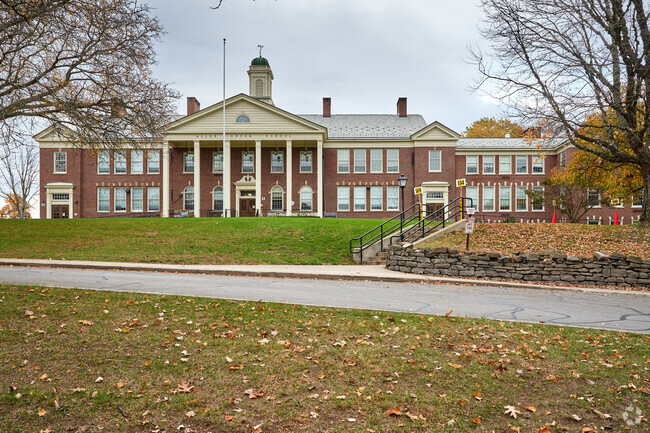
Hagen was one of hundreds of children who attended Allen Creek School. Founded in 1815 as Brighton District No. 6 school, it held classes in private homes until 1818, when a one-room school was built to accommodate scholars aged 5 to 15 from November through March.
Increasing enrollments following WWII, made it necessary to explore options for a more economical way of educating Allen Creek graduates beyond the 8th grade. The voters in this early district approved annexing the school to Pittsford School District. With the annexation of Allen Creek School occurring in July 1958, it became the 4th school in Pittsford School District. At the time of annexation, there were 380 students attending Allen Creek School.
Conor, you should feel honored to be member of a small community that had such a profound impact on this great country of ours.